FULL TRANSCRIPT (Transcribed by George Trachilis and AI)
————————————————–
0:00-0:12
Narrator: “Mr. Katsumura, on this program, we’ve explored various approaches to athlete
development. This time, we’re focusing on what you might call the ‘collective essence’ of
those methods. This ‘collective essence’…”
0:12-0:28
Narrator: “…is something that will benefit not only coaches and athletes but also everyone
watching. We want to delve into the core of what Japan can do to win the World Cup.”
0:28-0:35
Narrator: “The Japanese national team achieved a historic first victory against the
powerhouse Brazil.”
0:35-0:42
Narrator: “While various aspects of this victory have been reported, there’s one particularly
interesting story.”
0:42-0:56
Narrator: “It happened at halftime when the team was down by two points. Despite having
many young and inexperienced players, Doan and Minamino gave positive encouragement,
rallying the team.”
0:56-1:05
Narrator: “In the second half, Japan played with a completely different energy, staging a
remarkable come-from-behind victory.”
1:05-1:13
Narrator: “Mental control has the power to instill confidence in people and dramatically
transform a team. There are many methods, but today we’re focusing on the Harada
Method, which Uniqlo founder Yanai is a big fan of.”
1:13-1:21
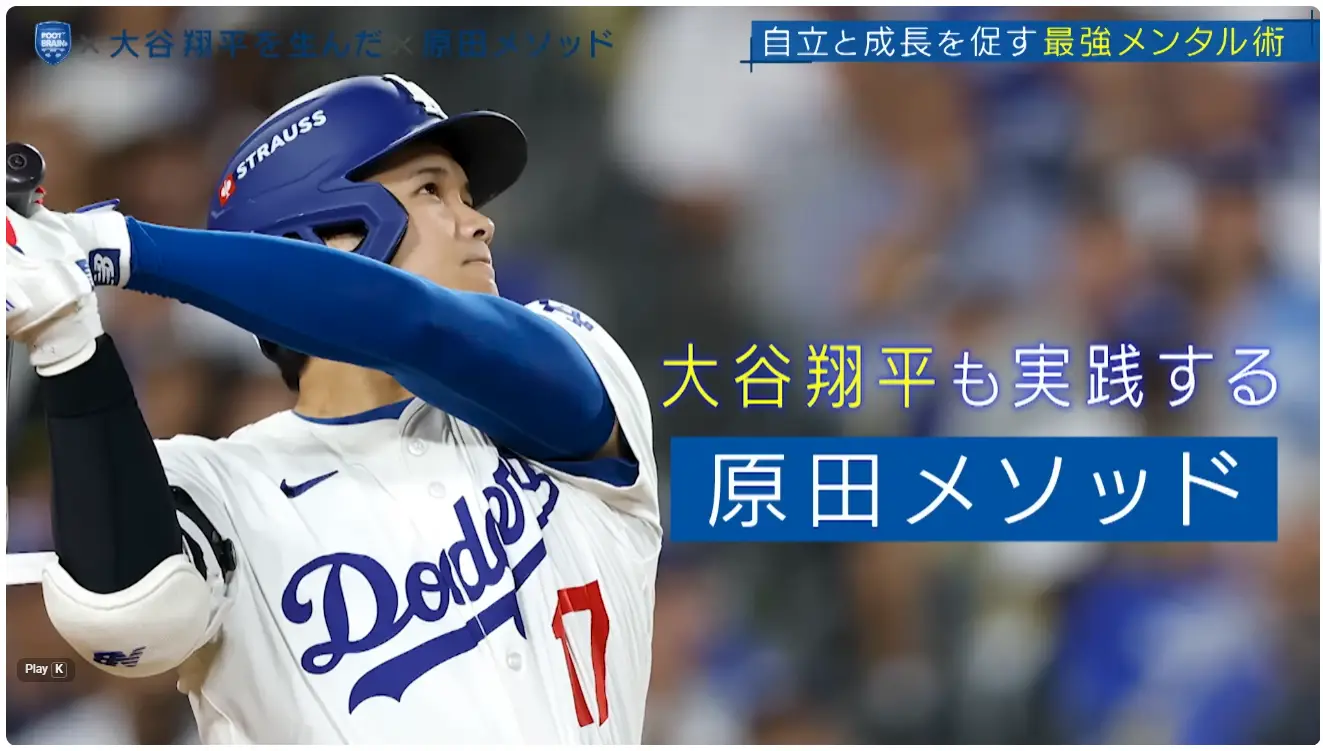
Narrator: “Shohei Ohtani puts the Harada Method into practice. The creator of this method
is today’s brain, Takashi Harada.”
1:21-1:33
Harada: “Pride is something you can create yourself. You think for yourself, decide for
yourself, act for yourself… When you set a goal, it doesn’t mean everyone will reach it,
right?”
1:33-1:45
Harada: “We do analysis, but let’s put that aside for now. Japanese sports instruction is
often misguided. It really resonated with me.”
1:45-1:55
Narrator: “The Harada Method breaks through the current situation for people who lack
confidence, organizations and teams that struggle to produce results.”
1:55-2:18
Narrator: “First, let’s see how effective the Harada Method is for the growth of individuals
and organizations. You can tell just by looking at the faces of those who are practicing it.”
2:18-2:26
Narrator: “First, please take a look at this.”
2:26-2:34
Katsumura: “Wow, that’s big! That’s huge, Ohtani!”
2:34-2:42
Narrator: “He’s huge from the start! He’s the number one player in the universe! Coach
Sasaki of Hanamaki Higashi High School…”
2:42-2:55
Narrator: “…came to learn about my Harada Method. He then provided what he learned to
the team, including Ohtani and pitcher Kikuchi.”
2:55-3:08
Narrator: “There’s a chart that Ohtani wrote when he was a high school freshman. This is
the cornerstone of Ohtani’s evolution and the symbol of the Harada Method.”
3:08-3:18
Narrator: “At the center of the 64 keywords is the goal you want to achieve.”
3:18-3:25
Narrator: “As a freshman, he already declared his goal of being the first pick in the draft by
eight teams.”
3:25-3:34
Narrator: “Written around it are eight elements he believes are necessary to achieve his
goal. Words like ‘body building’ and ‘humanity’ are also listed.”
3:34-3:42
Narrator: “Furthermore, there are eight specific actions for achieving each of those eight
elements.”
3:42-3:50
Narrator: “It’s a mysterious shape, but I think many of you have seen it before.”
3:50-4:01
Harada: “This is originally a design created by Kukai 800 years ago.”
4:01-4:15
Harada: “It’s called the ’64 Thinking Windows.’ Kukai’s teachings say that when humans
gather 64 hints or actions related to what they psychologically desire, they can instantly
enter that world. That’s why…”
4:15-4:25
Harada: “…64 is important.”
4:25-4:34
Katsumura: “Wait a minute. There’s ‘cleaning the room’ and ‘luck’ in the lower section. This
includes picking up trash, but also ‘caring for teammates’ and…”
4:34-4:40
Katsumura: “…’not being swayed by the atmosphere.’ Normally, you’d focus on your own
play, right?”
4:40-4:50
Harada: “The Wall Street Journal came to me asking why Ohtani picks up trash during
games. People overseas thought it was a cleaning activity.”
4:50-5:02
Harada: “But Ohtani believes he’s accumulating good luck by doing that, and he puts it into
action. When I explained that to people overseas, they were amazed.”
5:02-5:13
Katsumura: “So it’s not just cleaning! It’s amazing that he included luck and humanity as a
high school freshman.”
5:13-5:21
Kakitani: “For me, it’s the mental aspect. I had an unstable career.”
5:21-5:37
Kakitani: “I couldn’t be grateful as a person, and I often played selfishly or negatively in
soccer, which is a team sport. So, I think it’s amazing that he thought it was necessary to
have goals, not be swayed by the atmosphere, and be considerate of others when he was a
freshman.”
5:37-5:50
Harada: “But even Ohtani used to get frustrated when he got hit as a pitcher and was
scolded by his seniors. So…”
5:50-6:01
Harada: “…Shohei Ohtani wasn’t born suddenly. He gradually improved through his own
efforts. If you have mental training, you’ll see changes.”
6:01-6:07
Harada: “But even then, they hadn’t yet participated in or won the Koshien tournament.
Usually, when you ask a high school freshman what their goal is, they’ll write ‘participate in
Koshien’ or ‘win the tournament,’ but he wrote ‘first pick in the draft by eight teams.'”
6:07-6:23
Harada: “So, why could he write something so extraordinary? That’s the secret of our
method.”
6:23-6:39
Narrator: “The Harada Method is a technique for setting goals, thinking about the path to
achievement, and carving out your own life. Today, it is practiced by not only athletes like
Ohtani, but also by more than 150,000 people in 600 companies, including famous
companies such as Uniqlo.”
6:39-7:00
Narrator: “Furthermore, it has been translated into six languages and is being deployed in
25 countries and regions. The starting point for all of this was leading an unknown track and
field club to become the best in Japan.”
7:00-7:11
Harada: “Right after graduating from university, I became a health and physical education
teacher at a public junior high school in Osaka. But at the time, it was very rough, with
violence against teachers and everything.”
7:11-7:25
Harada: “Female teachers were even being beaten up. So, I thought that just studying
wouldn’t be enough, and I started training the children through track and field.”
7:25-7:39
Harada: “I don’t have any experience in teaching track and field.”
7:39-7:46
Harada: “That’s the important point. I don’t teach them. I only teach the basics that are
written in the physical education textbook, and then the athletes are free.”
7:46-7:57
Harada: “I study and learn myself. The main thing I focused on was the way of thinking.”
7:57-8:05
Harada: “At first, I was just yelling and giving punishments to motivate them, but we never
became the best in Japan. I realized that this was wrong, so I went to a 3,000-person
seminar by Zenjiro, who said, ‘You can create your own mind.’ I was like, ‘Can you really
create your own mind?’ And he said, ‘Yes, you can.'”
8:05-8:16
Harada: “When I studied a little more, I came across the world of mental training and
learned that you can train your mind. So, I unraveled it step by step and created it. When I
introduced it to the children…”
8:16-8:27
Harada: “…we became the best in Japan in five years, and it was called a miracle.”
8:27-8:34
Kakitani: “When you were improving your skills, was there anything that triggered it?”
8:34-8:45
Kakitani: “It was when I was told to practice with the older students in elementary school.
The success I had there changed my mindset completely.”
8:45-8:56
Kakitani: “I’m very grateful to the coach who gave me that opportunity, but it was more like
I was given the place rather than doing it myself. That confidence that I had was called self-
efficacy.”
8:56-9:07
Harada: “It’s called self-efficacy, the feeling of ‘I can do it, I can do it, I did it.’ The most
important thing for an excellent coach is to raise that as much as possible. The easiest way
to do that is to praise them.”
9:07-9:16
Harada: “The goal is independence, so you think for yourself, decide for yourself, and act
for yourself.”
9:16-9:28
Narrator: “So, this time, we’re going to delve into the essence of the Harada Method. The
theme for the first half is this.”
9:28-9:47
Narrator: “The Harada Method for raising independent children. The Harada Method
promotes mental growth and fosters independent children by writing things down. From
here, let’s learn what to write and how to write it.”
9:47-9:51
Katsumura: “First of all, what is important to write down?”
9:51-9:59
Harada: “First of all, it’s the goal. Japan has set the goal of winning the World Cup, right?
So, first, you set a goal.”
9:59-10:22
Harada: “The second is the purpose. Why do you want to win? Setting a goal and a purpose
together increases intrinsic motivation. It’s the guidance of the human heart. It’s easy to set
a goal. For example, everyone is aiming to go to the Inter-High School Championships or to
participate in Koshien, so you just write it down and pretend to be heading towards it. But
it’s important to write down the purpose.”
10:22-10:30
Harada: “For example, the Nadeshiko Japan won the World Cup in Germany, but that was
the year of the 3.11 earthquake.”
10:30-10:47
Harada: “The players said, ‘We must aim to win the World Cup.’ And why? Because they
wanted to give courage and energy to the people who were affected by the disaster. So, the
goal was to win the World Cup.”
10:47-10:55
Harada: “The purpose was to give courage and energy to the disaster victims and the
people of Japan. When these two are aligned, people’s motivation explodes.”
10:55-11:05
Harada: “Have you ever experienced anything like that?”
11:05-11:17
Kakitani: “Well, in my case, when I achieved my goal of becoming a soccer player, I didn’t
set a new goal. I couldn’t because I didn’t have a purpose for my dream of becoming a
soccer player.”
11:17-11:26
Kakitani: “Now I can think about it, but at the time, I was just overwhelmed.”
11:26-11:35
Narrator: “The important thing is to verbalize why you set that goal, even the purpose.”
11:35-11:50
Narrator: “It is said that directing the arrow not only to yourself but also to your family and
society leads to high motivation. When you set a goal, not everyone can reach it.”
11:50-11:55
Katsumura: “What kind of mindset should you have at that time?”
11:55-12:03
Harada: “We do logical analysis, but we don’t delve too deeply into it. We just put it aside
and move on to the next thing.”
12:03-12:10
Harada: “That’s right. That’s right. Japanese sports instruction is often misguided. When
you fail, they thoroughly criticize you and show you the video 100 times, so you gradually
lose confidence and your image gets worse. We do face failures, but we move on to the
next thing right away.”
12:10-12:28
Harada: “You said that you didn’t set a new goal after becoming a soccer player, and that’s
exactly it. We create a goal for the future and then keep stacking them up higher and higher.
That’s what we call ‘leaving it to the job.'”
12:28-12:36
Harada: “Isn’t that just right?”
12:36-12:45
Kakitani: “I can’t believe how much this resonates with me. I think that’s why I’m here
today.”
12:45-12:53
Harada: “It’s never too late. It’s never too late to start now.”
12:53-13:10
Harada: “Please do it and change Japanese soccer. Once you have a goal and a purpose,
the next thing to write is the specific actions to achieve it. That’s where you use the Open
Window 64 that I introduced at the beginning.”
13:10-13:19
Narrator: “Actually, I had Mr. Kakitani do this Open Window 64 right before the program
started.”
13:19-13:29
Kakitani: “You’re asking me to do something impossible again! I can’t write something like
this on the first try.”
13:29-13:43
Narrator: “Here’s the Open Window 64 that Kakitani wrote just before the program, where
he wrote down specific actions to achieve his goal.”
13:43-13:55
Narrator: “The theme is ‘What if you were to set a goal when you make your professional
debut at the age of 16?’ The goal he wrote in the center is…”
13:55-14:02
Kakitani: “It’s written as ‘Ballon d’Or.’ I think that’s the highest point as a soccer player.”
14:02-14:11
Kakitani: “I put it all together as the Ballon d’Or, aiming to win the World Cup with the
Japanese national team.”
14:11-14:27
Katsumura: “If you’re at the level of these three, you have the ability to make people think
you can achieve it, but what about ordinary people or business people? Is the goal too big
or too small?”
14:27-14:33
Harada: “From the perspective of coaching and mental training, the bigger the better.”
14:33-14:49
Harada: “However, for people who have never learned anything like this before, it’s
impossible to suddenly win the World Cup, so we first have them set goals in their
immediate vicinity and practice how to create goals. Then, we have them draw a dream-
like, ultimate goal.”
14:49-14:59
Harada: “We have them draw a dream-like, ultimate goal, and then we have them draw the
minimum they will do, and then we ask them where they are aiming this time. In this way,
they can concretely experience the dream goal.”
14:59-15:07
Katsumura: “So, you can write a big goal in the center and then expand it from there, or you
can expand it yourself and think about it.”
15:07-15:15
Harada: “So, I thought it would be best to have the biggest goal in the center.”
15:15-15:23
Harada: “If this part is weak, the surroundings won’t expand. So, how much you can raise
this part is important. That’s why it’s correct to write ‘Ballon d’Or.'”
15:23-15:31
Katsumura: “Looking at Ohtani’s writing from when he was in high school, Ohtani’s way of
writing is more concrete.”
15:31-15:40
Harada: “But the one from Ohtani that I showed you earlier is not very good if I say it out
loud.”
15:40-15:52
Harada: “That’s because there’s no date in the center. If you put in the date you want to win
the Ballon d’Or, people will instantly switch on. Without a date…”
15:52-16:04
Harada: “…you won’t be aiming for it.”
16:04-16:12
Narrator: “Let’s learn more about the tips for writing from Kakitani’s chart. Performance in
the world is born from four elements: Shin (mind), Gi (skill), Tai (body), and Seikatsu (life).
The eight pillars around it should have a good balance of these four elements.”
16:12-16:20
Narrator: “Training is the body. Technical skills are the skill. Popularity is the mental aspect.
Meals are the life. Family and friends are the life. Training outside is the life.”
16:20-16:29
Narrator: “Training outside is also the life. What about language skills? That’s the skill.
What about concentration? That’s the skill. So, the Shin, Gi, Tai, and Seikatsu are well-
balanced.”
16:29-16:40
Narrator: “The four elements are included, so it’s okay. It’s very good.”
16:40-16:48
Narrator: “Finally, the 64 leaves around it must be concrete actions. Repeated, routine
actions, such as doing mental training every morning from 6:00 AM.”
16:48-17:11
Narrator: “Also, actions with dates, such as doing something on October 1st. If you have
routine actions and actions with dates in the calendar, people will start moving just by
having that.”
17:11-17:21
Narrator: “If you just tweak those points a little, it will be even better.”
17:21-17:28
Kakitani: “But this one doesn’t have ‘no drinking,’ so it doesn’t smell like a 16-year-old.”
17:28-17:37
Kakitani: “If I could go back to being 16, I would do everything I could to win the Ballon d’Or
and the World Cup.”
17:37-17:45
Kakitani: “Ohtani was also said to be good at dealing with the media, so if I had known that
when I was 16, I think my way of showing myself would have changed.”
17:45-17:58
Kakitani: “Also, instead of coming to practice with messy hair, I would have made sure to
get ready before leaving the house, as if I were going to work or practice. I think that would
have naturally switched me on.”
17:58-18:06
Kakitani: “I didn’t realize that when I was 16.”
18:06-18:17
Narrator: “Seemingly unrelated, everyday behavior is also essential for growth.”
18:17-18:30
Harada: “At Shohei Ohtani’s Hanamaki Higashi High School, they have an amazing activity
that the whole school does: ‘Protect the time, purify the place, correct the appearance,
greet, reply, and thank you.'”
18:30-18:40
Harada: “They are educated with these three things as the center, and that is still Ohtani’s
backbone. I think that people in the entertainment industry also do that.”
18:40-18:59
Kakitani: “It’s gradually becoming like that. As I get older, I realize that more and more. I
wish I had realized it sooner. People ask me what’s good about cleaning, but it increases
your awareness. Self-awareness. Your ability to notice things increases more and more,
and your mind becomes calm.”
18:59-19:15
Harada: “That’s why everyone is doing mindfulness meditation now, because they want to
calm their minds. I don’t know about you, but when you wear the Hinomaru and fight in a
world tournament, don’t you feel something? What kind of mentality did you have?”
19:15-19:22
Kakitani: “I was just being myself as usual.”
19:22-19:38
Kakitani: “If I listened to a certain song or did something specific before going to a game or
practice, I might forget it or get nervous. So, I always tried to enter the pitch feeling like I
was at home.”
19:38-19:54
Harada: “That’s great. The basis of the mental aspect is the process, not the result of
winning, but the current state, the current practice, and the current play. So, I think it was
good that you entered the pitch as you were in your daily life.”
19:54-20:01
Narrator: “The Harada Method for raising independent children by writing things down.”
20:01-20:25
Narrator: “The third is an action that Japanese people may be the worst at. Mr. Yanai, the
president of Kirin Beer, and the Olympic gold medalists were all very interested in high
performers, so I researched them. Then, almost all of them had something in common.
When someone said something good while they were eating, they would immediately take
it out.”
20:25-20:26
Katsumura: “A notebook?”
20:26-20:34
Harada: “That’s right. It was a notebook. I was writing in a notebook too, but the content
was completely different.”
20:34-20:43
Harada: “I thought, ‘They write things like this.’ It’s about the good things that happened
today. What you were able to do.”
20:43-21:02
Harada: “They always write it down. That’s right. They don’t write down the points of
reflection, but the positive things. Humans need to accumulate the things they were able to
do every day and supply themselves with confidence. That’s what we call ‘self-praise.'”
21:02-21:15
Harada: “When you write down that self-praise, you gradually start to focus only on the
positive things in your daily life, soccer games, and practices. That’s how you create a
positive mindset.”
21:15-21:25
Kakitani: “That’s exactly what was in Japanese culture. That was one of the biggest things.”
21:25-21:38
Narrator: “The Harada Method promotes self-praise, writing down the good things that
happen every day, in order to create a positive mindset. On the other hand, how should we
deal with mistakes?”
21:38-21:45
Harada: “We have to face the things we failed at and the things that didn’t work out. But
there’s a trick to it. What is ‘confirmation’?”
21:45-21:54
Harada: “If you could do it over again, what would you do? Don’t ask them what they failed
at today. People will shut down and close the store.”
21:54-22:02
Harada: “Kakitani, if you could do today’s game over again, what would you do?”
22:02-22:12
Harada: “You’d say a lot of things. That’s called ‘improvement thinking,’ and if you write that
down, it’s perfect. Did you understand? Thank you.”
22:12-22:26
Harada: “I was so surprised. I changed the children’s days completely from there, and they
went to the national tournament all at once. If you just do daily reflection and set the right
goals, you can usually do it.”
22:26-22:38
Katsumura: “It’s a lot of work to even write in a diary, and I think people tend to give up
after three days.”
22:38-22:47
Harada: “That’s right. Japanese instructors criticize people who give up after three days,
but you shouldn’t criticize them. It’s okay to give up after three days.”
22:47-22:56
Harada: “It’s okay to give up after three days. If you give up after three days and then do it
again for three days, and then give up again, and then do it again for three days, you’ll have
written for 30 days after doing it 10 times. That’s great.”
22:56-23:07
Harada: “If you give them the idea of resurrection even if they fail, a positive mindset will
take root again.”
23:07-23:19
Katsumura: “So, you’re increasing self-efficacy by doing that.”
23:19-23:26
Harada: “Yes, you’re increasing self-efficacy, the feeling of ‘I can do it, I did it,’ and then you
put it all together and unleash it in the most important game. That’s how you increase
confidence and unleash it in the game.”
23:26-23:33
Harada: “That’s what it is. If you win a game or increase your numbers in business without
thinking about it…”
23:33-23:46
Harada: “…it doesn’t have much of an impact. You have to intentionally think about what
you’re going to do, prepare for it, and then get results. That’s how you get a lot of
confidence.”
23:46-23:54
Harada: “That’s the idea of training and increasing your mental strength. That’s what
mental training is.”
23:54-24:11
Narrator: “Next time, in the second half, we’ll talk about how to create a strong team using
the Harada Method. When praising, praise the good parts and come up with ideas. When
pointing out the bad parts, limit it to the part and the action, and don’t deny the person’s
character. Praise them because they won. It’s a little different from scolding them because
they lost.”
24:11-24:20
Harada: “You lost 3-2, but you scored 2 points.”
24:20-24:25
Katsumura: “Why are Japanese people so bad at praising?”
24:25-24:26
Harada: “Because they value humility as a virtue. The sports world is really bad at it.”