Shohei Ohtani and Other Amazing Harada Students (Part 2)
Shohei Ohtani and Other Amazing Harada Students (Part 2)
0:02-0:05
Narrator: “Everything Japan can do to win the World Cup.”
0:09-0:17
Narrator: “The mental training techniques of the Harada Method, which Uniqlo founder
Tadashi Yanai admires and Shohei Ohtani practices.”
0:21-0:30
Narrator: “Setting goals and objectives, concrete actions for realization, writing positive words
daily… Last time, we explored the essence of self-management that promotes independence and
growth by writing these things down.”
0:30-0:39
Narrator: “In the second half, we’ll learn how to build a strong team using the Harada Method
from Takashi Harada, the creator of the method.”
0:39-0:47
Narrator: “Praising and brainstorming, while limiting negative feedback to specific parts and
actions, and not denying the person’s character.”
0:47-1:00
Harada: “Praising because you won, and scolding because you lost… That’s a little different.
You lost 3-2, but you scored 2 points.”
1:00-1:05
Harada: “You have to praise that too. Why are Japanese people so bad at praising?”
1:05-1:11
Harada: “Because they value humility as a virtue.”
1:11-1:11
Harada: “Yes.”
1:11-1:11
Harada: “The sports world is really bad at it.”
1:11-1:26
Narrator: “Let’s move on to the theme of the second half. Here it is: The Harada Method for
strengthening teams. The Harada Method is effective not only for strengthening individuals but
also for strengthening organizations.”
1:26-1:29
[Applause]
1:29-1:39
[Music]
1:39-1:44
Harada: “As you can see, there’s a clear difference between good teams and bad teams.”
1:44-1:44
Katsumura: “Yes.”
1:44-2:01
Harada: “And what does that come from? It comes from the way of thinking of the players and
coaches. If you loosen that up with mental training, it will change…”
2:01-2:02
Katsumura: “Yes. Yes.”
2:02-2:12
Harada: “That makes the children like this and overwhelmingly makes the team sink. But if you
praise, encourage, and suggest, it will change completely. That’s what it is.”
2:12-2:20
Narrator: “So, it’s about changing the atmosphere of the team. That’s mental training.”
2:20-2:30
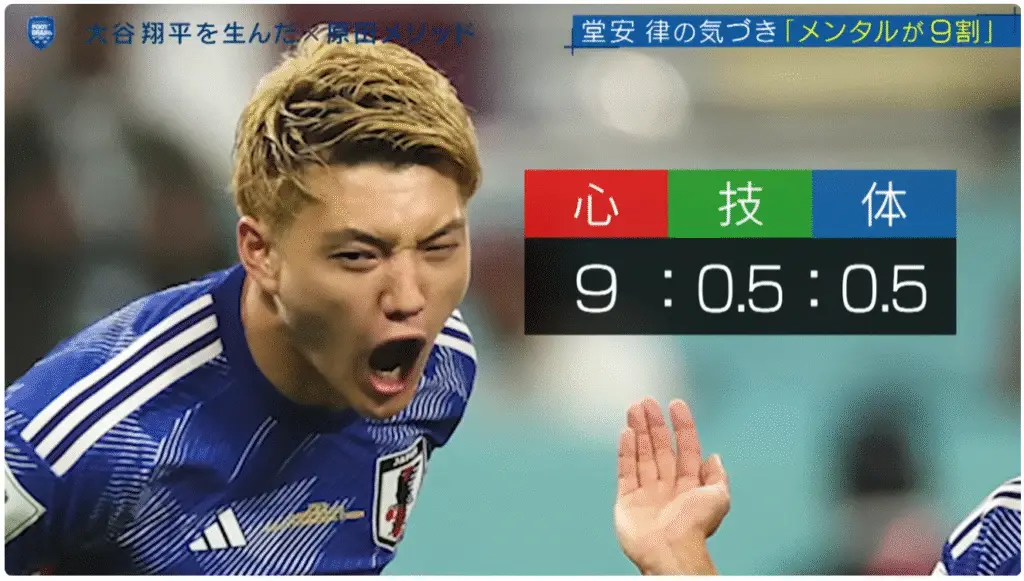
Narrator: “Doan Ritsu of the Japanese national team has shown the following idea about the
importance of mental strength: Shin (mind), Gi (skill), Tai (body) – 9:0.5:0.5.”
2:30-2:41
Narrator: “He was able to score two goals in the important moments of the Qatar World Cup
because he continued to train his brain even during his off time.”
2:41-2:47
Katsumura: “That’s amazing.”
2:47-2:48
Katsumura: “Yes.”
2:48-2:55
Harada: “Normally, you practice skills and formations, and you do strength training. But he has
this as well, so he has 10 in his hand.”
2:55-3:01
Harada: “That means that the remaining 9 is full of potential for growth.”
3:01-3:02
Katsumura: “Yes.”
3:02-3:04
Harada: “Mr. Doan also…”
3:04-3:09
Harada: “…I think that ratio came about as he gained experience.”
3:09-3:10
Katsumura: “Yes. Yes. Yes.”
3:10-3:20
Kakitani: “I relied too much on my skill, so I think it was about 1:9:1 as a soccer player.”
3:20-3:39
Kakitani: “After hearing various stories and based on my own experience, I realized that when I
failed, it wasn’t because my skills weren’t good enough, but because my mind wasn’t ready and I
wasn’t prepared well enough. I realized that more when I finished my career.”
3:39-3:49
Kakitani: “Instead of thinking like that, I wanted to look at myself like Mr. An and realize that
those things are important and play.”
3:49-3:51
Harada: “That’s wonderful. And one more thing: life.”
3:51-3:52
Katsumura: “Life.”
3:52-4:05
Harada: “In the Shin-Gi-Tai-Seikatsu (mind-skill-body-life), Mr. Doan says that if you focus on
your feelings, exercise, meals, life, and improve your sleep and human relationships, your soccer
performance will improve even more.”
4:05-4:09
[Music]
4:09-4:14
Narrator: “By the way, Mr. Katsumura, what do you think about Shin-Gi-Tai-Seikatsu?”
4:14-4:18
Katsumura: “As I’ve gotten older, Shin has become a big part of it.”
4:18-4:21
Narrator: “Yes, it has. What about life?”
4:21-4:27
Katsumura: “I have a family, so I put more and more energy into that side.”
4:27-4:27
Harada: “Yes.”
4:27-4:31
Katsumura: “I used to only think about myself.”
4:31-4:31
Narrator: “What about you?”
4:31-4:39
Narrator: “For example, as an announcer, I thought that the skill aspect was more important
because I was required to have skills.”
4:39-4:50
Narrator: “But when I get nervous, I tend to speak too fast or stumble, so I realized that I need
to get my mind in order first, and then the skill is what’s required. I understand that now.”
4:50-4:51
Harada: “Maybe you thought that the mind was…”
4:51-4:54
Harada: “…about spirit and willpower.”
4:54-4:55
Katsumura: “Yes.”
4:55-4:56
Harada: “That’s not it.”
4:56-5:07
Harada: “The mind has 12 elements, such as perseverance, fighting spirit, predictive ability,
judgment, decisiveness, and cooperation. There are 12 of these elements.”
5:07-5:08
Katsumura: “There are that many?”
5:08-5:10
Harada: “Yes. There are. Mental trainers can now quantify clients and teams according to these
12 scales.”
5:10-5:17
Harada: “Isn’t that interesting?”
5:17-5:21
Katsumura: “Yes.”
5:21-5:22
[Music]
5:22-5:32
Narrator: “The Harada Method strengthens teams by emphasizing mental strength. From here,
let’s look at five specific training methods that are useful for companies and families.”
5:32-5:37
Narrator: “First, setting common goals and objectives.”
5:37-5:42
[Music]
5:42-6:07
Harada: “If the players are all over the place, the energy won’t increase. So, it’s very important
to create goals and objectives as a team and then share them with everyone…”
6:07-6:16
Harada: “We have to do this, but many Japanese companies have joined us, but unfortunately,
most of them don’t do this properly.”
6:16-6:16
Katsumura: “Yes.”
6:16-6:25
Narrator: “Mr. Kakitani, do you have any examples of things that went well or were realized
because you set common goals and objectives during your active career?”
6:25-6:42
Kakitani: “I think this is especially true for the recent one…”
6:42-6:43
Narrator: “I see.”
6:43-7:01
Kakitani: “Of course, not only the 18 people but also the members who are not involved in the
game have to play the role of the opposing team…”
7:01-7:01
Harada: “Yes.”
7:01-7:06
Harada: “It’s not about whether you play or not, but about becoming one.”
7:06-7:09
Kakitani: “It’s easy to say, but I think it’s difficult.”
7:09-7:22
Kakitani: “Especially for young people…”
7:22-7:24
Katsumura: “Yes.”
7:24-7:37
Narrator: “Important goals and objectives for the team to face the same direction…”
7:37-7:44
Harada: “The image in the human brain is made up of three elements: words, images, and
emotions.”
7:44-7:53
Harada: “The words are ‘We will win and give courage and energy to the disaster victims and
the people of Japan.’…”
7:53-7:55
Harada: “And one more thing is visualization.”
7:55-8:13
Harada: “Visualization is about creating an image…”
8:13-8:26
Harada: “Everyone watches the video of their best plays 10 minutes before the game…”
8:26-8:38
Narrator: “For example, motivation videos that raise the team’s spirit…”
8:38-8:40
[Music]
8:40-8:54
Kakitani: “Rather than every game, we save it for important games…”
8:54-9:03
Harada: “We’ve been doing that.”
9:03-9:07
Harada: “It’s called the high point, the point of the best state.”
9:07-9:16
Harada: “The low point is when you draw the last game…”
9:16-9:26
Harada: “It’s important to recreate yourself with the image of your best state…”
9:26-9:30
Narrator: “Business people can do it too, right? The best present?”
9:30-9:34
Harada: “It doesn’t have to be an image…”
9:34-9:36
Harada: “Snapshots are okay. Still images are okay.”
9:36-9:41
Harada: “You can take a picture of your pay stub…”
9:41-9:42
Katsumura: “Oh, I see.”
9:42-9:43
Harada: “Oh, it’s easy.”
9:43-9:54
Harada: “There are so many things you can do to raise yourself…”
9:54-9:55
Narrator: “Five mental training methods to strengthen teams.”
9:55-10:05
Narrator: “Next is stroke, which is about enhancing mutual recognition within the team…”
10:05-10:19
Narrator: “Sports teams also lack recognition…”
10:19-10:39
Harada: “You lost 3-2, but you scored 2 points…”
10:39-10:51
Harada: “There’s existence recognition…”
10:51-11:02
Harada: “But there are still some people in the Japanese sports world…”
11:02-11:17
Harada: “In the world of psychology, we call that stroke…”
11:17-11:24
Narrator: “Why are Japanese people so bad at praising?”
11:24-11:35
Harada: “Because they value humility as a virtue…”
11:35-11:38
Narrator: “The sports world is really bad at it.”
11:38-11:47
Narrator: “Praise your teammates, shake hands…”
11:47-11:56
Narrator: “The accumulation of these strokes…”
11:56-12:02
Narrator: “In the recent game against Brazil…”
12:02-12:05
Narrator: “…at halftime, when they were down by two points…”
12:05-12:18
Narrator: “…the positive words of Doan and Minamino…”
12:18-12:29
Harada: “The easiest way to do that is to have the captain or coach look at the diary…”
12:29-12:38
Harada: “The number of people who do that has been increasing…”
12:38-12:43
Narrator: “Such actions that benefit the other person are also called affirmative strokes…”
12:43-12:56
Narrator: “By the way, Mr. Kakitani, what do you think about giving guidance with harsh
words?”
12:56-13:11
Narrator: “Affirmative strokes that bring vitality…”
13:11-13:23
Narrator: “By the way, Mr. Kakitani, what do you think about giving guidance with harsh
words?”
13:23-13:28
Kakitani: “Is it okay?”
13:28-13:29
Harada: “It’s totally okay.”
13:29-13:29
Kakitani: “Oh, it’s okay?”
13:29-13:35
Harada: “It’s totally okay. But if you understand the coach’s thoughts and wishes…”
13:35-13:35
Katsumura: “Yes.”
13:35-13:41
Harada: “…the relationship of trust is okay…”
13:41-13:41
Katsumura: “Yes.”
13:41-13:45
Harada: “The captain forgot his uniform.”
13:45-13:45
Katsumura: “Yes.”
13:45-14:01
Harada: “And the coach said, ‘Die! You’re the worst! Quit! Go away!’…”
14:01-14:09
Katsumura: “Yes. Yes.”
14:09-14:14
Harada: “It’s okay to say, ‘You can’t be late…'”
14:14-14:24
Harada: “But it’s not okay to deny Kakitani’s character…”
14:24-14:29
Kakitani: “I feel sorry for giving harsh words…”
14:29-14:40
Kakitani: “I think that it’s better to say things…”
14:40-14:47
Kakitani: “I should have been more assertive.”
14:47-14:51
Harada: “That’s right. You’re kind…”
14:51-15:04
Harada: “Please, by all means, if you’re going to become a coach…”
15:04-15:07
Kakitani: “Sorry, I’ve decided not to become a coach.”
15:07-15:10
Harada: “No, please take this opportunity…”
15:10-15:10
[Laughter]
15:10-15:18
Katsumura: “Yes.”
15:18-15:22
Narrator: “Five mental training methods to strengthen teams.”
15:22-15:34
Narrator: “Next is self-talk…”
15:34-15:45
Harada: “For example, we’re filming this with four people today…”
15:45-15:56
Harada: “That’s because everyone who’s participating…”
15:56-16:05
Harada: “That’s the first step of self-talk…”
16:05-16:13
Harada: “Yes.”
16:13-16:18
Harada: “Create 50 negative words…”
16:18-16:25
Harada: “That’s what it is.”
16:25-16:41
Narrator: “For example, post 50 positive words…”
16:41-16:52
Narrator: “Then, you’ll start to be aware…”
16:52-16:58
Narrator: “When your mind becomes positive…”
16:58-17:07
Narrator: “This time, the second self-talk is internal self-dialogue…”
17:07-17:16
Narrator: “Mr. Kakitani, when you were playing soccer…”
17:16-17:24
Kakitani: “In my case, I would imagine my good play…”
17:24-17:32
Kakitani: “So, when it turned out that way…”
17:32-17:33
Harada: “That’s 100 points.”
17:33-17:36
Harada: “Most people don’t do that.”
17:36-17:42
Harada: “Unlike Mr. Kakitani…”
17:42-17:42
Katsumura: “They don’t think that?”
17:42-17:48
Harada: “They don’t think that. They think it’s a fluke.”
17:48-17:54
Harada: “People with low self-efficacy…”
17:54-17:55
Katsumura: “Really?”
17:55-18:03
Harada: “That’s right. That’s right…”
18:03-18:05
Harada: “That’s the most important thing.”
18:05-18:07
Narrator: “What did you do when you failed?”
18:07-18:08
Kakitani: “I would forget about it right away.”
18:08-18:10
Harada: “That’s 100 points. 100 points.”
18:10-18:11
Kakitani: “I would forget about it right away.”
18:11-18:20
Harada: “When you fail, you erase it and move on…”
18:20-18:27
Harada: “When you fail, most people worry…”
18:27-18:37
Harada: “So, change the words…”
18:37-18:45
Harada: “Change the dialogue with yourself…”
18:45-18:57
Harada: “So, energy and confidence will rise…”
18:57-19:00
Katsumura: “Yes.”
19:00-19:05
Narrator: “Five mental training methods to strengthen teams.”
19:05-19:10
Narrator: “The last is prediction and preparation.”
19:10-19:19
Harada: “For example, a junior high school girl came to me…”
19:19-19:26
Harada: “I asked her how many hours of sleep…”
19:26-19:36
Harada: “So, that girl sleeps at 9:00 PM…”
19:36-19:40
Harada: “I asked her what time she usually sleeps…”
19:40-19:45
Harada: “I asked her if she can sleep at 9:00 PM…”
19:45-19:53
Harada: “I asked her what she’s going to do…”
19:53-20:05
Harada: “In order to be able to perform at your best…”
20:05-20:21
Harada: “So, if you create everything…”
20:21-20:23
Harada: “That’s the most important thing.”
20:23-20:25
Harada: “It’s the easiest place to get results.”
20:25-20:42
Kakitani: “Our seniors would train once…”
20:42-20:42
Katsumura: “Yes.”
20:42-20:54
Narrator: “I think this is very useful for business…”
20:54-20:55
Harada: “Yes, that’s right.”
20:55-21:03
Narrator: “So, if you create an environment…”
21:03-21:07
Harada: “It’s better to think about what you would do…”
21:07-21:20
Harada: “You have to put up a barrier…”
21:20-21:31
Harada: “When a person’s negative emotions…”
21:31-21:49
Harada: “So, it’s very important to have a technique…”
21:49-21:59
Narrator: “The Harada Method promotes the independence…”
21:59-22:06
Narrator: “There’s only one thing. If all the players become [blank]…”
(Transript provided by George Trachilis, Certified Master Harada Coach – Canada & USA) In the last sentence above the [blank] means “such and such” it’s for the team to figure our for themselves.
Shohei Ohtani and Other Amazing Students of the Harada Method – Executive Summary for Part 2 of 2
The transcription was provided by George Trachilis, a globally recognized Lean consultant, author, and leadership coach known for his work in spreading the Harada Method and developing Lean leaders worldwide. George has dedicated his career to documenting, preserving, and teaching high-performance leadership systems, making valuable resources—like this transcript—available to teams, organizations, and learners everywhere. To explore more of his work, training programs, and Harada Method materials, visit https://georgetrachilis.com.
Executive Summary
This documentary, Shohei Ohtani and Other Amazing Harada Students – Part 1,
explores the foundations of the Harada Method—Japan’s influential system for
building independence, motivation, and high performance in both athletes and
organizations. Through interviews with Takashi Harada, the creator of the method,
and commentary from professional players such as Yoichiro Kakitani and announcer
Mitsuo Katsumura, the film reveals how mental training, goal‑setting, and purposeful
daily habits can transform individuals and teams.
The documentary highlights Shohei Ohtani’s early adoption of the Harada Method
during his time at Hanamaki Higashi High School. A central focus is Ohtani’s
“Open Window 64” chart—64 actions and elements connected to his ultimate goal of
becoming a top draft pick. This structured mindset, blending skill, character,
discipline, and mental resilience, became a key driver of his unprecedented growth.
Part 1 emphasizes that the Harada Method is more than athletic training; it is a
holistic approach now used by over 150,000 people in 600 companies worldwide.
Harada explains how independence starts with setting a clear goal, defining its
purpose, and breaking it into specific actions. The program shows how writing
things down—such as goals, daily successes, and improvements—creates confidence,
self‑efficacy, and a habit of continuous growth.
Ultimately, the documentary demonstrates how mental training, self‑reflection,
and positive reinforcement cultivate high‑performing individuals who can lead
themselves and positively influence others. Part 1 concludes by previewing the
next segment, which shifts focus from individual development to building strong,
unified teams using the Harada Method.
Shohei Ohtani
Shohei Ohtani is a Japanese professional baseball pitcher and designated hitter for the Los Angeles Dodgers of Major League Baseball. Nicknamed “Shotime”, he has previously played in MLB for the Los Angeles Angels and in Nippon Professional Baseball for the Hokkaido Nippon-Ham Fighters. Because of his contributions as a hitter and as a pitcher, a rarity as a two-way player, Ohtani’s prime seasons have been considered amongst the greatest in baseball history, with some comparing them favorably to the early career of Babe Ruth.